
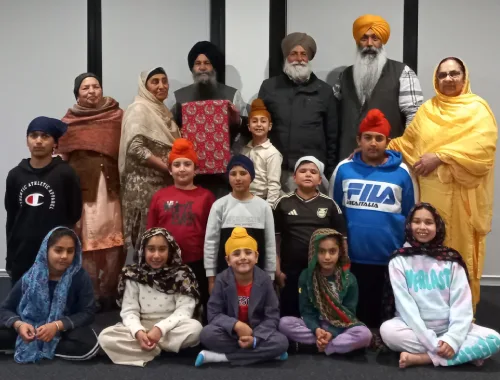
Why Language Learning Builds Lasting Confidence
Why Language Learning Builds Lasting Confidence
When a child can speak with confidence in the language of home, they often carry that confidence into the classroom, their friendships, and everyday life. That is why heritage language learning is about much more than vocabulary. It helps children feel grounded in who they are while growing stronger in how they communicate, learn, and connect with others.
More Than Just Another Subject
For many families, mother-language learning starts as a cultural goal. Parents want their children to understand family conversations, speak with grandparents, take part in traditions, and keep an important part of their identity alive. Those are powerful reasons on their own.
But the value goes further. The Australian Curriculum explains that language learning helps young people develop a deeper understanding of language, culture, and identity, and that this contributes to both wellbeing and academic development. In other words, learning a heritage language is not separate from personal growth. It can be part of it. (australiancurriculum.edu.au)
That matters for families in Canberra, where many children are growing up in multicultural homes and learning to move confidently between different settings. A child who feels secure in one part of their identity is often better placed to participate confidently in others.
Confidence Starts With Communication
One of the biggest heritage language learning benefits Canberra families notice is simple but important: children become more comfortable expressing themselves.
At first, that may look small. A child answers back in Punjabi instead of English. They understand a family story without needing it translated. They join a cultural performance without feeling hesitant. Over time, those moments build self-belief.
Children gain confidence when they can understand and be understood. They feel less like observers and more like active participants in family life. That matters especially in homes where parents or grandparents naturally switch between languages. When children can keep up with those conversations, they are not just learning words. They are building belonging.
This kind of confidence is often visible outside the home too. Children who practise listening, speaking, reading, and writing in more than one language can become more attentive communicators overall. They learn to notice context, meaning, tone, and audience. Those are valuable life skills in school and beyond.
Language Learning Can Strengthen Everyday Learning Habits
Parents sometimes worry that adding another language will overload a child’s schedule. In reality, a well-structured program can do the opposite. It can help children build discipline, routine, and stronger study habits.
Language learning asks children to listen carefully, remember patterns, practise regularly, and apply what they know in different ways. Those habits can support broader learning, especially when teaching is steady and age-appropriate.
The Australian Curriculum also recognises Languages as one of the key learning areas for students, alongside subjects such as English, Mathematics, Science, and The Arts. That reinforces an important point: language learning is not an “extra” with no educational value. It is a recognised part of a well-rounded learning journey. (australiancurriculum.edu.au)
For school-aged children in the ACT, that can be especially valuable when heritage language classes are approached as a consistent part of weekly development rather than an occasional cultural activity.
Cultural Connection Builds Social Confidence Too
Children do better when they feel connected, not divided, between home and the outside world.
Heritage language learning gives children a way to understand the stories, values, humour, traditions, and expressions that shape family life. It helps them answer questions about who they are with greater ease. Instead of feeling unsure about their background, they are more likely to carry it with pride.
That matters in multicultural communities across Canberra, Queanbeyan, and Googong, where many families want their children to grow up confident in both Australian life and their cultural roots. The goal is not to choose one identity over another. It is to help children move comfortably between both.
The ACT Government’s Community Language School Program reflects that broader community value. It says the program supports more than 2,000 Canberra students in language and culture, and that it helps build connection, social cohesion, and stronger family ties through shared language. (ACT Government)
That is a useful reminder for parents: mother-language learning is not just private family interest. It is part of how communities stay connected across generations.
Why This Matters in Canberra
Canberra families often look for learning options that are practical, structured, and meaningful. They are not just asking, “Will my child attend?” They are asking, “Will this actually help my child grow?”
That is the right question.
In the ACT, community language schools are already recognised as out-of-hours learning environments for school-aged children, and official guidance has noted that these programs may include both language learning and cultural activities. That model suits many families because it allows children to build skills outside the standard school timetable while staying connected to culture in a regular, organised way. (ACT Legislative Assembly)
For families searching for mother-language support in Canberra or multicultural learning opportunities in the Canberra region, the best programs usually combine consistency with relevance. Children respond better when lessons feel connected to real life, family communication, culture, and their stage of learning.
What Parents Should Look For
Not every program creates the same result. If the goal is lasting confidence, parents should look beyond the idea of “classes” and focus on the learning environment itself.
A strong program usually offers:
Regularity
Children build confidence through repetition and routine, not one-off exposure.
Age-appropriate teaching
A Year 1 student and a Year 10 student need different pacing, different expectations, and different ways of staying engaged.
Real language use
Children should not only memorise words. They should use the language in speaking, listening, reading, writing, and cultural understanding.
Positive reinforcement
Confidence grows when children feel safe to try, make mistakes, and improve without embarrassment.
A sense of purpose
The strongest programs help children understand why the language matters in their own life, not just in theory.
When parents choose a learning environment with those qualities, they are not simply adding another activity to the week. They are investing in communication, identity, and long-term confidence.
A Stronger Foundation for the Future
A confident child does not appear overnight. Confidence is built through small, repeated experiences of understanding, achievement, and belonging.
That is what makes heritage language learning so valuable. It helps children speak more comfortably, connect more deeply with family, and feel more secure in who they are. For Canberra families, that can become an important part of raising children who are not only academically capable, but also culturally grounded and socially confident.
If you are exploring a supportive path for heritage language and cultural learning in Canberra, Sarkar-E-Khalsa International Incorporated can help you learn more about the Canberra initiative it supports and whether it may be the right fit for your family.
